
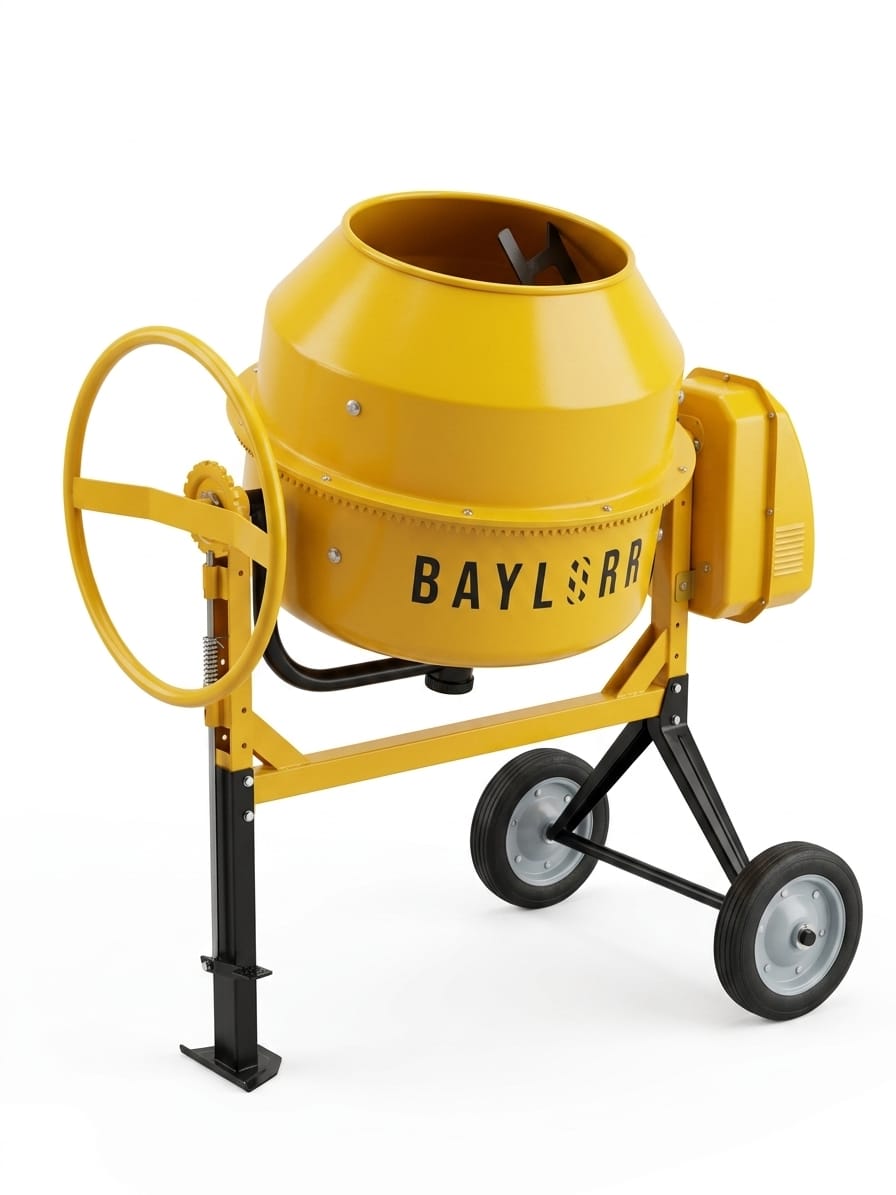
In the UAE's construction environment — 45°C summers, tight project schedules, and sites that often lack reliable services in their early stages — a concrete mixer that is undersized, underpowered, or poorly maintained becomes a bottleneck fast. The right machine handles your daily volume without overheating, suits your power supply, and survives the conditions.
Here's what to check before you buy.
1. Choose the right mixer type for your work
The most common type on UAE sites is the tilting drum mixer — a rotating steel drum on an inclined axis that mixes concrete by tumbling. It handles general site concrete well: column kickers, blinding, kerbs, small slabs. Available from 130 litres to 500 litres.
For higher-consistency work — screed mortar, precast elements, tile adhesive — a pan mixer (forced action) uses rotating paddles to mix rather than gravity tumbling, producing a more uniform result regardless of aggregate size or mix stiffness.
If the machine needs to move between floors or travel to different site areas frequently, a portable mixer on a wheeled chassis keeps your team from having to carry concrete rather than mix it where it's needed.
2. Get the drum size right
Rated capacity is the geometric drum volume. Working yield — the concrete you actually get per batch — is roughly 50–65% of that number.
- 130–180L rated (80–100L yield): repair patching, lightweight villa works, small infill pours
- 250–350L rated (150–200L yield): villa construction, kerbs, slabs up to 50m²
- 400–500L rated (240–300L yield): medium civil works, compound infrastructure, higher daily volume
Undersizing a mixer and running it continuously wears the drum, motor, and bearings faster than running a correctly-sized machine at reasonable capacity.
3. Petrol or electric?
Petrol works anywhere — no power connection needed, which makes it the right choice for early-stage greenfield sites across the UAE where three-phase supply isn't connected yet. Higher fuel cost and more maintenance than electric over time.
Electric (single-phase 220V or three-phase 380V) is quieter, cheaper to run, and lower-maintenance once your site has power. Confirm which supply is available before ordering — running a three-phase machine on single-phase isn't possible without a step-up transformer.
4. Hot weather mixing — what UAE sites need to do differently
Cement hydration accelerates in heat. At 40°C+, your workability window shortens significantly compared to the lab conditions mix designs are tested at. Practical steps that make a real difference:
- Mix in the early morning or evening during June–September
- Use chilled or cold water — water temperature directly affects initial concrete temperature
- Pre-wet the drum before loading — a hot steel drum absorbs mix water from the first batch
- Use a retarding admixture for pours where extended workability is critical
- Never add extra water to compensate for heat-related stiffness — it lowers the water-cement ratio and reduces final strength
5. Maintenance that keeps a mixer running in UAE conditions
Dust, heat, and daily use are hard on equipment. A simple routine prevents most failures:
- Tumble-clean the drum with water and coarse gravel after the last batch every shift — hardened concrete in a UAE summer sets within hours
- Check and tighten drum mountings and bolts weekly — vibration loosens fastenings continuously
- Lubricate the ring gear and pinion monthly
- Check engine oil every 50 hours on petrol models — oil degrades faster in high ambient temperatures
- Inspect motor brushes and electrical connections on electric models — dust ingress is the leading cause of motor overheating on UAE sites
Which Baylorr concrete mixer is right for your project?
Tell us your typical daily volume, available power, and how often the machine needs to move and we'll recommend the right model. Browse concrete mixers or contact us for same-day pricing and delivery across the UAE and GCC.